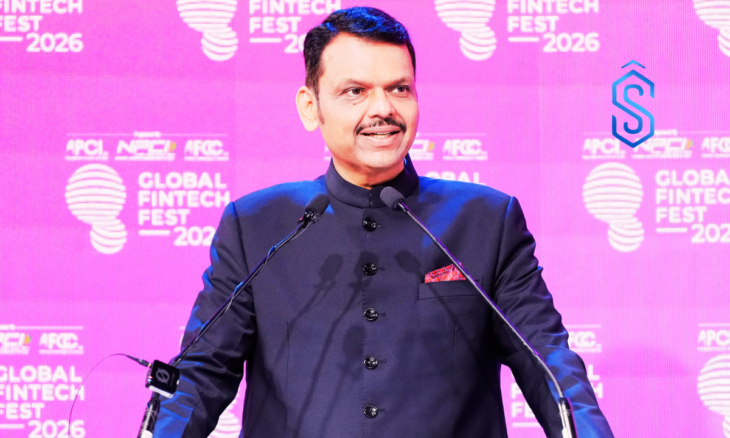
Mumbai: Maharashtra is working towards becoming India’s first “tokenized state” through a proposed legal framework (Maharashtra Tokenisation Framework) for blockchain-based tokenisation of land and other immovable assets.
Speaking at the Global Fintech Fest 2026, Maharashtra Chief Minister Devendra Fadnavis said, “Maharashtra had moved beyond discussing the concept of tokenisation and was now working towards putting the required architecture in place.
Maharashtra Digitisation and Exchange of Land Token Asset Act, or the DELTA Act, is aimed at creating a legal framework for blockchain-based tokenisation of land and other immovable assets.
The Maharashtra tokenisation plan is centred on the large value locked in physical assets, particularly land and real estate.
According to Fadnavis, the opportunity could be as large as ₹50 lakh crore. The objective is to use technology to unlock this dormant capital and improve the ability to use such assets productively.
Maharashtra Tokenisation Framework to Focus on Land and Real Estate
The proposed DELTA Act is expected to provide the legal framework required for the Maharashtra tokenisation initiative.
Fadnavis said the idea was discussed at the previous Global Fintech Fest and government will be bringing the architecture into place.
“Our objective is to create a legal framework for the blockchain based tokenization of land and other immovable assets and we are doing it carefully.
We are bringing together expertise from SEBI, BSE, NSE, industry, technology, law and academia because innovation at this scale must be accompanied by legal certaintity, consumer protection and regulatory trust,” Fadnavis said.
The operationalisation of the DELTA Act will require significant collaboration between the Government of India, institutions and the Government of Maharashtra.
Tokenisation Positioned as a Way to Unlock Dormant Capital
Fadnavis positioned Maharashtra tokenisation plan as an effort to address the gap between asset ownership and liquidity.
“For generations, land has represented wealth in India. But very often it is wealth without liquidity. A family may own an asset of significant value but still struggle to access capital against it efficiently, while an entrepreneur may have an asset but may not be able to unlock its economic potential quickly,” Fadnavis said, while stressing that tokenisation is about unlocking productive capital and it should not be viewed primarily through the lens of speculation.
Agentic AI to Give Citizens Greater Financial Agency
Beyond Maharashtra tokenisation, Fadnavis highlighted agentic AI as the second major transformation taking place in financial technology. “The first generation of digital finance gave the people access. The next generation can give the people agency,” he said.
Fadnavis also outlined potential applications of agentic AI for MSMEs, farmers and citizens. An MSME entrepreneur, for instance, could have an AI assistant that understands cash flows, anticipates working capital requirements, identifies appropriate financing and helps with financial decisions.
The future of finance must combine intelligence with accountability, innovation with consent, speed with security and agents with human oversight, Fadnavis stated.
Quantum Identified as Third Fintech Frontier
The third frontier identified by CM Fadnavis was quantum technology, particularly in the context of financial security and cryptography.
He noted that billions of financial transactions depend upon cryptography and said that changes in computing power would require corresponding changes in security architecture.
Fadnavis said that if India is to build one of the world’s largest digital economies, it must also aspire to build one of the world’s most trusted and resilient digital economies. Fintech, therefore, must consider the next architecture of trust.
Maharashtra Wants to Become a Fintech Laboratory
Fadnavis also outlined a broader vision for Maharashtra’s fintech ecosystem, bringing together finance technology, AI, data infrastructure and innovation.
Mumbai has a deep financial ecosystem, while Pune has technology and engineering talent. Navi Mumbai is emerging as a centre for infrastructure, data innovation and global connectivity.
The state is building an ecosystem around AI, data centres, GCCs, startups, universities and advanced technology, according to CM Fadnavis.
He also said that Maharashtra was prepared to work with innovators, institutions and regulators to test responsible solutions at scale.
Mumbai Envisioned as a Global Finance Innovation Hub
Fadnavis said, “Mumbai should increasingly become the city where the future of global finance is designed. The next great global fintech company can be born in Mumbai.
The next global financial protocol can be designed here. The next innovation in digital public infrastructure and the next breakthrough in responsible financial AI could emerge from Mumbai.”
Maharashtra to Become Large-Scale Fintech Test Bed
Fadnavis concluded with another major commitment linked to the state’s fintech ambitions. “Maharashtra will become India’s largest real world test bed for the next generation of fintech.
The government would work with innovators to test these solutions responsibly, deploy them at scale and take successful solutions to the world,” he said.